BLOG HAS MOVED

This blog has moved to thealteredscale.blogspot.com. Please make a note, and I look forward to seeing you there.
Showing posts with label Wreckage of Reason. Show all posts

Monday, November 24, 2008

Interview with Barbara Baer

This is one of a series of interviews with the authors whose work is collected in Wreckage of Reason, an anthology of experimental short fiction by women. To read the other interviews, click "Wreckage of Reason" at the bottom of this post.

1. This is the first piece of fiction that I have encountered that uses MySpace and other technological media as its setting. Do you know of others? why did you choose it? what possibilities did it open for you?

I suppose there must be others using it but I just got the idea because of hearing about it used so much, especially Second Life. Of course it opened possibilities, as it does for people who communicate and create personas there.

2. Is the title a play on 'girl germs'?

No, it is a play on jeans as well as being about genes.

3. I assume you consider this a satire. What do you consider are the objects of your satire? Why do you want to make fun of them?

Yes, satire or fantasy. My intent wasn't to make fun of them as much as enter into a possible world with them where I'd hope a reader would feel sadness, despite the grotesque nature of their afflictions.

4. What is your view on medical experimentation and so-called medical 'progress'?

Very dark. I'm glad people are helped by medical intervention, would hope the same for myself, but I envision all sorts of cloning. I used to be a reader of sci fi. Who can see Blade Runner and not feel the likelihood andthe tragedy of the mutants?

5. This story is in a tradition that goes back at least as far as MaryShelley's "Frankenstein" -- one that bears witness to the dangers of scientific experimentation. Did this tradition affect your writing at all? That is to say, did you feel stymied because of it, supported by it, or didyou not even sense it while writing?

As a former sci fi reaader, one interested in the fantastical, of course Shelley comes to mind. It's all out there, from the mutant movies to what seems very poppular on mainstream tv, all the alien and mutant shows, people with special powers. But to me there's always been the dark side. The human brain came up with nuclear fission and we can blow up everything. I've always felt that the thanatopic side would hold sway in the end, with a few survivors. Obviously others think this way, or want to immunize themselves from believing it will happen by creating horror stories. I once wrote an essay (Commonweal, but I don't remember date, cover story) about the differences between male and female apocalyptic scenarios, so the subject has fascinated me, probably most of all to try to understand what would be last-moment, last-moment-on-earth, strategies and sensations.

Saturday, November 15, 2008

Interview with Kass Fleisher

This is the third in a continuing series of interviews with the short story writers anthologized in Wreckage of Reason, a collection of experimental short fiction by women writers. To see the other interviews, click Wreckage of Reason at the end of this post.

"Generation" by Kass Fleisher is an uproarishly funny, but also complexly layered story. In it, she collages questions about standard grammar, quotations from an academic paper, and a narrative about an upset women on psychotropic drugs that make peeing and reaching an orgasm difficult.

1. The story is built around eight questions about standard grammar (subject, verb, dependent clause, etc.). In your afterword you mention "offensive advice about sentences." With this comment, are you referring only to these questions, or to other aspects of the story as well?

I find texts in the strangest places-and in this instance I was standing in a classroom waiting for students to finish some small-group work, and I found this awful old grammar book on the shelf. I suppose that if you truly can't communicate in writing because your grammatical practices deviate *that* much from the standard, then that might be a helpful book to read. But how does telling writers what not to do actually teach them how to mimic the standard? Doesn't it just intimidate people further? And if readers internalize these vicious little rules to the point that they're incapable of reading anything else-the play that exists in language just dies. What institutionalization does to us is: kill the joy we took in Dr. Seuss. So many possibilities are eliminated. And then too what I loved about this book-sorry I have no memory of the title; I think we've all seen them-the body of each chapter is composed in imperatives, but the chapter titles are questions. "How can a run-on sentence be corrected?" Well, why should it be? And so this piece of mine contains many of those (although not necessarily run-ons in the technical sense of that word). What does it mean to "correct" "error"? What social and institutional impulses are at work in that? To me it feels kind of scary, and puts me in mind of Chomsky's famous nogrammatical sentence, "Colorless green ideas sleep furiously." Kind of a nice line of poetry, that. What does the standardized reader do when confronted with artistic "error"?

This is an over statement, but I put all of that together with "I have seen the best minds of my..."; and the title is "Generation," so: "Howl." (See below for where, but I'll finish this point here.) No, minds aren't being laid waste by standardized grammar, but those sorts of institutionalized controls are doing some serious damage. We have fond memories of Dr. Seuss but can't read Beckett. Culturally, we're a bunch of languaging robots.

2. I have heard of a distinction between "collage" and "montage," in which the former refers to putting together unlike things, while the latter refers to collaging with an evident point in mind. Is this a useful distinction to use in thinking about your piece?

It's lovely of you to ask this question, and my answer is that I have no fucking idea. I would suspect collage, since I don't see  within this piece the sort of narrative progression with which montage is typically associated. I hope that the book as a whole (The Adventurous, from which this is an excerpt) sees the fragments come together, so to speak, in a point at the end. No fair asking me what the point is, though!

3. In your afterword, you make mention of using Ginsberg's "Howl" in writing this story. I wasn't able to find any places where you lifted directly from the poem. Did I miss something? Or do you use him in a nonliteral fashion?

Yes, I know, I was horribly clever-it's buried in the eight subtitles. I just couldn't bear to use the word "sentence" in reciting the questions raised by the source text, so it goes: 1. How can [I] fragments be eliminated? 2. What are the major errors in [have] structure? 3. How can a wordy [seen] be improved? Writers should be shot for being so clever.

4. You cross off words and phrases, mostly when you are working with the "Distant Intellectual" discourse that you quote. What is your aim?

I wanted to look at the notion of "grammar" as exacted by the expectations for literary scholarship and oppose that with the rant-based syntax of this nutty woman who can't pee. The source text is an actual essay in a book written by my partner Joe Amato; he and I edit each other's work, and we can be fairly cruel about it-at least, I suspect, to people who don't know that this is just how we deal with writing. We're brutal, but we're each fine with that (mostly). And I had been reading his paper and making these comments and thecontent of his paper was actually relevant to what I was trying to achieve: "outsider moves" becoming "insider strategem," etc. So it was another one of those accidents, and I have a lot of problems with his prose style-he's a great poet; I would never touch a line-but prose-wise he can be inscrutable. So there I was with my authoritarian red pen telling him (in marginalia) that he's "driving me fucking nuts!!!" What kind of hypocrite am I, right? So I put the whole thing in there; his original, the edits I made, and my comments. I found the final affect to be entirely disruptive; I don't know how readers experience the piece, but that aspect of found text was just a mess, in my view, typographically and otherwise, which I hope makes the point that editing is intrusive, destructive-much as we all seem to love the phrase "constructive criticism." (What does that mean???)  And, what we have here is a plain-terms rant juxtaposed with a rant disguised as literary scholarship. Each grammar is extensive, but to different affect.

5. A character in the story who has taken psychotropic drugs for "anger" is having difficulty peeing and achieving orgasm. It seems that the academic and scientific (drugs) discourses can oppress and even possess the body.

Fuckin-A. And what I love is how PISSED she is about that, tee hee. There's just no one she's not mad at-the poor woman in the next stall, the people in line, the drugs, and herself for being so angry that she has to be on them. She even gets mad at the feds: Rocky Mountain National Park enjoys the highest day traffic of any of the Parks, because of its proximity to Denver, and only two years ago they built a respectably-sized rest room. Unbelievable. More below, but before moving on: I wanted to bring the female body into a variety of grammars that just don't recognize it. You could argue that no sort of body is permitted, unless you view serial assertion as phallic, which I do (sue me). I far prefer questions to answers, circularity to penetration (I'll stop there). But here's a truth: Joe and I do a lot of hiking, and above treeline he can just yank a zipper and whiz away. Me, not so much; and guide books don't typically include information about toilets, even when they exist. So clearly, the shy-bladder female is not welcome at 12,000'. That PISSES me off.

6. The woman who is having this difficulty gets angry with other women who are peeing and shitting around her. She even calls them "cunts" and "bitches." Does the scientific and intellectual use of language not only entrap women, but even turn them against one another?

Yes, it's all of that, and the way vernacular purportedly re-empowers women (and other Others) in the face of this strictly restrictive language standard (although vernacular doesn't actually empower anyone; it's a practice like any other that will shift with societal dynamics-some day the word "cunt" will possess zero power). Ultimately I wanted the woman to find ecstasy both in what some would call angry language and in orgasm (anger and orgasm, chemically, being not unrelated). That the lovers edit each other's language-and the tongue (doubled in meaning) is the basis for ecstasy-well, I'm not sure I want to mystify this too much. Perhaps the piece says that language will set you free-not sure. What I would say is that in the final analysis, what entraps women is patriarchal oppression, which is reflected by standardized grammars (masculinist), by the discourse practices of scholarship (masculinist), and yes, by a science that wants to numb both a woman's anger and her capacity to experience sexual pleasure (definitely masculinist!).

Sunday, October 5, 2008

Interview with Debra Di Blasi

Wreckage of Reason: An Anthology of Contemporary Xxperimental Prose by Women Writers  (Spuyten Duyvil) ed. Nava Renek

This is an interesting anthology that I would like to bring some attention to. I've decided that interviewing the short story writers about the particulars of their stories would be a provocative angle. I and some others will conduct these interviews. To see YouTube interviews with the editor and a few of the writers, go to Debra Di Blasi.

Below, is an interview with Debra Di Blasi.

Other interviews:

Debra Di Blasi's story "Sprung Up in the Years Since" is a collage fiction. In sidebars, set off with a light grey background, popular culture and political inanities are listed, followed by a final list of military terms. In numbered and titled narratives in the middle of the page stories of war in Africa appear: boy soldiers, rapes, forced conscriptions, slavery, torture. These narratives are interrupted by phrases in a grey font that may present a character's views on God, quotations from journalism and science and pop culture. Finally a number of illustrations appear throughout the story; of hands, mouths, eyes, and skeletal teeth.

1. You have some marvelous sentences in this story: "You cannot cross a new bridge without death swaggering drunk in your heart"; "But the ricochet silence that followed gunfire, the descending starlight of snare — drum silence in his ear that followed gunfire, bade the hungry locust enter. Ngabo felt each sword-bristle of leg, each tickle-snap of antennae, each buzz-flutter of wing in the silence, in the light, in the inexhaustible wellspring of blood under his boots sucking at the mud." What is so gripping about both of these sentences is that you bring together such seemingly disparate entities — a bridge and drunkenness, the sword bristle of a locust leg — in a vivid and coherent manner, not to mention your sudden return to the empirical reality of a soldier: boots and mud. 

Thank you for your kind comments. I’m not sure how to respond to this, except to say that I have, over the years, attempted to write as intuitively as I draw my visual art. One learns to trust the words and images that rise from the subconscious, that they will be precisely the right words, the most appropriately evocative images. Of course, one has to do one’s homework first, else the language simply is not available. That said, many of these new pieces draw from places in culture that, if one is paying attention, produce what Westerners might consider strange juxtapositions but are, to Africans, part of their culture. 

2. I am a little confused about the relationship of the sidebar to the horrific content in most of the main text. I see the juxtaposition of the pain and drama of people living at the edge of survival compared to the frivolity of celebrity culture. This appears again in section 6 where the voice of a prisoner who had his hands cut off is slowly drowned out by pop culture inanities written in a different font. 

Confusion is a good thing. 

Virtually all of my writing since my introduction to the World Wide Web explores the role of lacunae in our lives, certainly physical gaps in text and image, but also lacunae as existential metaphor for the gaps that occur in one’s body of knowledge – knowledge of other’s lives, of science, of history, of culture, of one’s self. What’s missing makes us who we are as much as what’s present; thus, we have people who think Sara Palin is smart. Until you begin at least asking yourself what’s missing, you cannot intelligently evolve as a human being. 

I expect my readers to be active participants, not passive, and therefore learn from whatever challenge I’m offering. When you study art history, for example, you’re required to analyze an artwork’s composition, medium(s), narrative, and historical/cultural references as they relate to you, the viewer so that you better understand the world around you. I want the reader to ask him/herself what is in fact the meaning of the gap between Paris Hilton and the mother feeding her daughter dust, between George W. Bush’s evident pride in his C-student status and an African captain biting off the breast of a girl-child after he rapes her. 

The structure of most of my stories since 1998 consists of mixed media fictions (texts + images) that subtlely or blatantly reference the architecture of the technological web and the interconnections in the web of living. I’m disgusted with most American (and world) literature that still clings to the 19th Century, that does not challenge our perceptions of “truth” or language or the media by which we’re inundated today, at this peculiar point in time. (I suspect such clinging is political, in the same way that the American educational system is political.) My intent is to manipulate the reader into an experience that says as much about the way we live today as do the events occurring within the story. 

3. In this story, what could be called the main character, Ngabo, 'allows' himself to be 'conscripted' as a boy soldier in exchange for his just-raped sister's life. Later, we see him raping an infant. To what extent is he a victim? 

The character of Ngabo is based on the child soldiers of Darfur and elsewhere in Africa who are stolen or forced to become killing machines. The idea of “choice” would not enter into the mind of a seven-year-old like Ngabo, who loves his sister and who is tremendously family-oriented, contrary to stereotypes you speak of in question 5, below. Ngabo is absolutely a victim, as are his young comrades who, we must assume, commit similar crimes out of an exponential madness resulting from traumas you or I cannot possibly imagine. As I write these African stories I know the situations are always worse – horrifyingly worse – than I can pen. I cannot, for example, make a reader experience every endless minute of every day of every five years a child soldier must endure, forced to kill and take the beatings and torture from the hands of his (or her) “leaders.” 

4. To what extent can the military horror in the portion of Africa that you are describing be blamed on the sadistic, perhaps unbalanced captain?

Oh, that’s too simplistic. The guerilla captain is essentially no different from the U.S. guards at Abu Ghraib who took obvious pleasure in torturing prisoners. No different from Enron executives remorselessly stealing life savings from thousands of their employees. No different from high school bullies, greedy mortgage lenders, abusive parents, intolerant religious leaders, corrupt politicians...perhaps no different from you or me. It’s the same fucking pot of offal. The circumstances create the results. Put a guy like Rush Limbaugh or Dick Cheney into a volatile environment wherein water and food are scarce and law has collapsed and see what happens. If tomorrow U.S. computers were hacked and our economy came to a dead halt, as it surely would, pandemonium would result as food and water ran out. History, ancient to contemporary, is full of sane men and women gone mad. 

5. Some readers may worry that this story plays into some stereotypes about Africa,that it's a lost cause where warlords run wild and there is no value put on human life? How would you answer them?

Not even Britney Spears is a lost cause (but ask me again tomorrow). 

If I believed Africa was a lost cause I wouldn’t be writing about it. I write about what I feel is important in comprehending the human condition – and what most writers can’t or won’t explore. “Sprung Up in the Years Since” is part of a new collection, nearly completed, of bifurcated and trifurcated fictions, many that contrast U.S. culture with African politics. The gap (there’s that word again) between First and Third World cultures shocks and dismays me, and I’ve seen it first-hand. Most Americans remain oblivious to what’s happening on the other side of the world. Ask 100 random people, “(1) Who is Robert Mugabe? And (2) who is Paris Hilton?” How many do you think would get the first part right? Yet millions of people are starving to death because of Mugabe – and perhaps because of Paris, too. Yes, I’m serious. The world is a system of interrelationships, one thing triggering another triggering another, ad infinitum. The space and time Paris takes up in the Western World’s psyche may in fact deflect attention from the ELEVEN MILLION PERCENT inflation in Zimbabwe. (By the way, all of the quotes by Paris, Lindsay, Britney, Ivanka and Dubya are real.) 

As for stereotypes? Africa’s a big damned continent – Egypt, Morocco, Kenya, Algeria, Liberia, Chad, Congo, Eritrea, Uganda... Each country has its own culture, it’s own level of success or failure. “Sprung Up” is one story about one region that has been in the news for the many years, now, though not nearly enough, in my opinion. The terrors of life in Darfur – from war to poverty and disease – should be on people’s minds more than, say, Lindsay Lohan but aren’t. Ngabo’s story begs this question. And Ngabo’s love for his sister, the mother’s love for her dying daughter, Farha’s love for her cousin…these too exist amid the muck as mystery that is love amid the ruins, to borrow a title from a classic novel. 

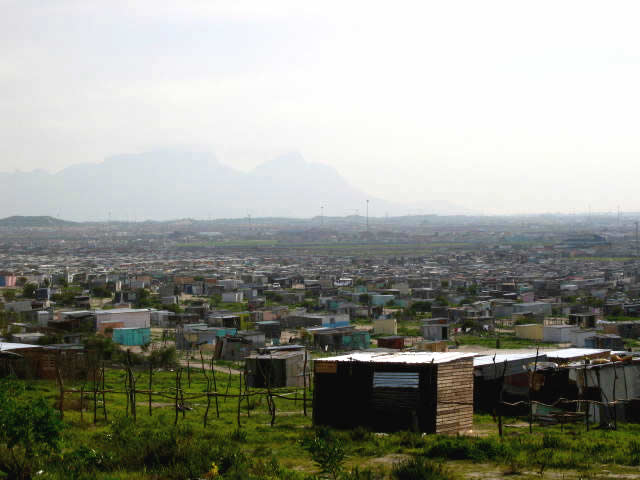
My recent mixed media fiction, “Quell the Mayhem Night”, takes place in a South African township where over a million people live like this, while I live like this when in South Africa.  The contrast is difficult to resolve and more economically complex than it appears.The two stories on which I’m working now also take place in South Africa.

6. What are your personal experiences with Africa and Africans? 

My husband was born and raised in South Africa. His parents were active in the anti-apartheid movement; his father was Nelson Mandela’s doctor during Mandela’s imprisonment. My husband still owns property in South Africa, so we travel there every year, spending about a month in Cape Town. In fact, just last week I returned from South Africa where political upheavals were rife. 

Though I’ve always been politically aware, since meeting my husband ten years ago, I’ve developed a passionate interest in the political and socioeconomic situations in South Africa, as well as some of the neighboring countries like Zimbabwe, especially because the contrast to U.S. culture is so great. And because the “cradle of civilization” is rotting from global neglect. It’s helpful to discuss the more intimate situations with S.A. nationals while I’m there, as the devil, said Mies van der Rohe, is in the detail[s]. I’d been reading about Darfur since the features of the conflict came to light. The concept of child soldiers sickened me; there are hundreds of thousands throughout the world. When I taught a war short stories class a few years ago, one of the sections focused on children in war; thus, sprang the seed for “Sprung Up.”

Last year in Cape Town, we viewed an exhibition of photographs of members of the Lord’s Resistance Army, notorious for stealing children (including girls whom they use as soldiers and/or for sexual gratification). It was the first time I’d seen a photo of the leader, Joseph Kony, on whom Ngabo’s captain is based. I found it grimly satisfying to see that my depiction of him was pretty damned accurate. Interestingly, and sadly, just two weeks ago, while driving in Cape Town, we heard that the Lord’s Resistance Army had just kidnapped 40 more children.

Wednesday, September 10, 2008

Wreckage of Reason: An Anthology of Contemporary Xxperimental Prose by Women Writers  (Spuyten Duyvil) ed. Nava Renek


This is an interesting anthology that I would like to bring some attention to. I've decided that interviewing the short story writers about the particulars of their stories would be a provocative angle. I and some others will conduct these interviews. To see YouTube interviews with the editor and a few of the writers, go to Debra DiBlasi

The first interview is with Lidia Yuknavitch, author of "Daguerreotype of a Girl."

1. Some may wonder why we need an anthology for only women writers. It seems that women have more publishing opportunities today than ever before.

i'm not sure i'd agree about all these publishing opportunities for women... i would say that more opportunities have opened up for a limited KIND of women's writing--particularly safe, traditional, confessional or market- driven writing.  but not for women writers who are taking the real risks in terms of language and narrative.  those opportunities remain tiny at best.  so books like this are in fact vital.


2. Is there anything specifically "feminine", however you define that term, about "Daguerreotype of a Girl"?

no, i wouldn't use the  term "feminine" per se--at least not in the english sense.  i would, however, be ok with the french inspired ecriture feminine, which has entirely different denotative and connotative implications.  that has a lot more to do with writing through the corporeal experience of being a woman and drawing new narrative forms.


3. What is the significance of using the name of a 19th- century photographic technique in your title?

i am trying to focus attention onto the artistic production of image-making. we live in a time where image-making is seamless and anyone can do it.  i wanted to reference the difficulty of image making — the mode of production being in the hands, that kind of thing.  the book that this piece appears in is partially about how it is we "make art."


4. Menas seems to be the name of a male, Egyptian saint. Were you making an allusion with this name?

well no, because Menas in Lithuanian  means (loosely) art.  The book's title as i say is Making Art.


5. It seems that in a number of places in the story, you imply that both art and desire emerge from either violence, a trauma, or a combination of the two. Am I correct?

yes--though you'd have to open those terms up--violence and trauma--to include the radical violence and trauma of beauty, of language, of sexuality, of biology, of spirituality.


6. You use a tremendous number of similes early in the story. These sentences in particular: "It may be more true that identity is as fully formed as the cosmos, as dna, as geographic actuality in the first moments of life. The open mouth as gaping as a galaxy. The unconscious wail. The physical violence. The irrelevancy of time or space"

are you trying to ask me why i use all those phrasings?  heh.  when i use those kinds of phrasings i'm trying to dislocate meaning from grammar and sentences and relocate  it/revision it in closer proximity to bodily experience and emotional intensities.